Use this decimal to percent calculator to quickly convert any decimal into a percentage in seconds. Get accurate results instantly with this easy-to-use decimal to percent converter for homework, finance, and everyday math.
Use this decimal to percent calculator to turn decimal values into percentages in seconds. Whether you need a quick decimal to percent converter for homework or a fast tool for everyday math, this calculator gives clear and accurate results with minimal steps.
How to Use This Decimal to Percent Calculator
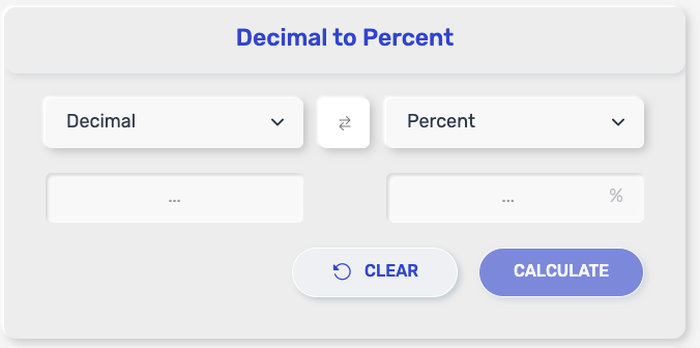
Using this decimal to percent calculator is simple. Enter your decimal value in the input box, then click the calculate button to get the percentage instantly. The tool will convert the decimal into a percent automatically, so you can check the answer without doing the math by hand.
Follow these quick steps:
Enter a decimal number, such as 0.25 or 1.5.
Click Calculate to see the result.
View the percentage output right away.
Check the formula or conversion steps if you want to understand how it works.
Click Reset to clear the field and try another decimal.
This calculator is useful for homework, quick checks, and everyday percentage conversions.
What This Decimal to Percent Converter Can Convert
This decimal to percent calculator can handle a wide range of values and turn them into percentage form in seconds. Whether you need a decimal to percent converter for a simple math problem or want to convert decimal to percent for school, work, or daily calculations, this tool makes the process quick and accurate. It is useful for basic decimal to percentage conversions, longer decimal values, and numbers greater than 1.
Standard decimal to percent conversions
Small decimals such as 0.05 and 0.125
Large decimals such as 2.75 and 3.5
Negative decimals such as -0.4
Decimal values with many digits
Whole numbers written in decimal form
Values greater than 1, such as 1.5 = 150%
What the Result Means
The result shows your decimal written in percentage form. When you use this decimal to percent calculator, the output tells you how much the value represents out of 100.
For example, if the result is 25%, it means the decimal is equal to 25 out of 100. A value like 0.25 becomes 25%, while 0.8 becomes 80%. If your decimal is greater than 1, the percentage will be more than 100%. For instance, 1.5 is equal to 150%.
This makes the result easy to understand in math, finance, data comparison, and everyday calculations where percentages are more familiar than decimals.
Decimal to Percent Formula Explained
To convert a decimal into a percentage, use this simple formula:
percent = decimal × 100
This means you multiply the decimal value by 100 to get the percent form. Another easy way to think about it is to move the decimal point two places to the right, then add the percent sign.
For example:
0.25 × 100 = 25%
0.8 × 100 = 80%
1.5 × 100 = 150%
This formula is the basis of any decimal to percent conversion and helps you understand how the calculator gives instant results.
Common Decimal to Percent Conversion Examples
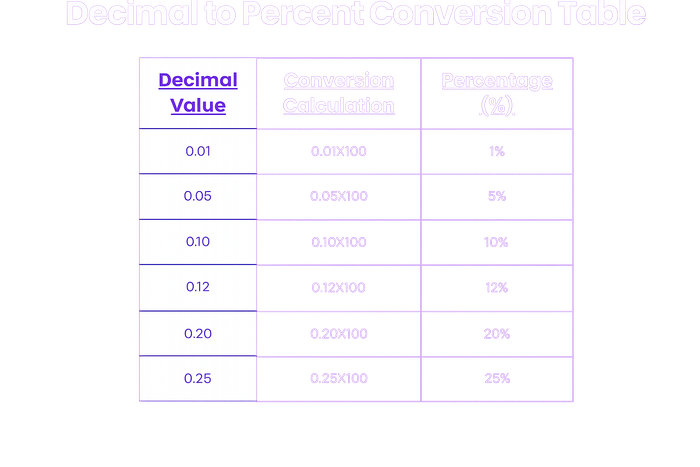
Below are some of the most common values people convert when using a decimal to percent calculator. These examples can help you check answers quickly and understand how decimal to percentage conversion works in everyday math.
0.01 = 1%
0.05 = 5%
0.1 = 10%
0.2 = 20%
0.25 = 25%
0.5 = 50%
0.75 = 75%
0.9 = 90%
1 = 100%
1.5 = 150%
These common conversions are useful for homework, finance, statistics, and quick mental math when you need to convert decimal to percent more easily.
Understanding the Difference Between Decimal and Percent
A decimal and a percent can represent the same value, but they are written in different formats. A decimal shows part of a whole using place value, while a percent shows that same value out of 100.
For example, 0.25 and 25% mean the same thing. The decimal form is often used in calculations, while the percent form is easier to read in finance, statistics, grades, and everyday comparisons. This is why a decimal to percent calculator is helpful when you want to change a number into a more familiar format.
How Decimals Greater Than 1 Convert to Percent
Decimals greater than 1 can also be converted into percentages. When you use a decimal to percent converter, the result will be more than 100% because the value is greater than one whole.
For example:
1 = 100%
1.2 = 120%
1.5 = 150%
2.75 = 275%
This is completely normal and simply means the value is larger than a full 100%. These conversions often appear in growth rates, data analysis, and percentage change calculations.
How Rounding Works in Decimal to Percent Results
Some decimal values do not convert into a clean whole-number percentage, so the result may need to be rounded. This usually happens when the decimal has many digits or repeats.
For example:
0.333 becomes 33.3%
0.6667 becomes 66.67%
0.1256 becomes 12.56%
Rounding helps make the result easier to read, especially in reports, schoolwork, and quick calculations. A decimal to percentage tool may show a rounded answer depending on how many decimal places are included in the original number.
When a Decimal Becomes More Than 100%
A decimal does not stop at 1, and neither does a percentage. Once a value goes above 1, the result will naturally be greater than 100%.
This works because 1 = 100%. So anything larger than 1 represents more than a full amount.
For example:
1.2 = 120%
1.5 = 150%
2.75 = 275%
This is completely normal and shows up often in real situations. A result above 100% usually means growth, increase, or exceeding a target. You might see it in performance reports, progress tracking, or comparisons where something goes beyond the original value.
So if your decimal to percent calculator gives a result over 100%, it is not an error. It simply means the value is more than one whole.
References
Math Is Fun – Convert Decimals to Percents https://www.mathsisfun.com/converting-decimals-percents.html
Khan Academy – Converting between percents, fractions, & decimals https://www.khanacademy.org/math/6th-engage-ny/engage-6th-module-1/6th-module-1-topic-d/a/converting-between-percents-fractions-decimals
Mathematics LibreTexts – 11.2.2: Converting Between Fractions, Decimals and Percents https://math.libretexts.org/Courses/Coastline_College/Math_Concurrent_Support_%28Tran%29/11%3A_Math_Support_for_Statistics/11.02%3A_Decimals_Fractions_and_Percents/11.2.02%3A_Converting_Between_Fractions_Decimals_and_Percents
Mathematics LibreTexts – 1.2: Converting between Fractions - Decimals and Percents https://math.libretexts.org/Courses/De_Anza_College/Pre-Statistics/1%3A_Decimals_Fractions_and_Percents/1.2%3A_Converting_between_Fractions_-_Decimals_and_Percents
FAQ
About us
Sometimes the smallest conversions make the biggest difference. Decimal-to-percent.com was built to help users turn decimal values into percentages quickly, clearly, and without unnecessary steps. Whether you're working on homework, reviewing data, handling finances, or checking calculations, this tool makes the process fast and easy to understand.
This tool was developed by the Decimal-to-percent.com team, with contributions from developers, content creators, and digital tool specialists focused on building simple, reliable resources for everyday problem-solving.
Policy
Clear tools should come with clear expectations.
No Data Collection
decimal-to-percent.com does not require sign-ups or personal information. Any values you enter are processed instantly and are not stored or shared.
Accuracy
This tool is designed to provide quick and accurate conversions from decimals to percentages. However, users should verify results when using them for academic work, financial decisions, or important calculations.
Intended Use
Built for convenience, this tool supports learning, quick checks, and everyday use. It is not intended to replace formal methods, detailed calculations, or professional guidance where precision is critical.
Updates
We may improve this tool and update this Policy over time. Any changes will be posted here to keep everything transparent and up to date.